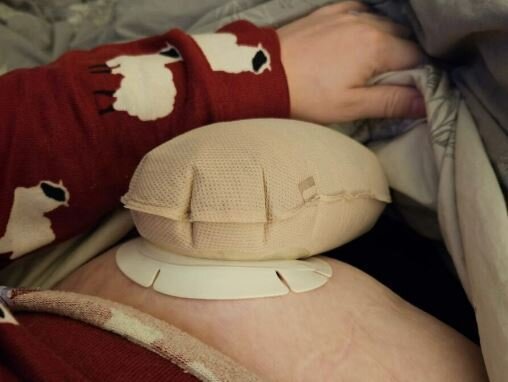
Ballooning is a term you might hear in relation to your stoma pouch but you might not understand exactly that is. Basically, it’s whenever your pouch fills up full of air whenever your stoma has produced some wind.
Releasing excess wind from your stoma pouch:
Drainable pouch
If you are wearing a drainable pouch and usually keep your pouch on for 3-4 days, you will find that ballooning will be more of an issue the longer you keep your pouch on. If possible, change your pouch more frequently, so the filter is working more effectively. Perhaps, getting in the routine of changing your pouch every 48 hours if you find ballooning is an issue. If you are wearing a drainable pouch it is much easier to empty the air out through the outlet.
Closed pouch
Whenever you have a colostomy and you are using a closed pouch, you might feel that ballooning is a huge problem. You could think about trying a two-piece pouch system so you’ll be able to ‘burp’ the pouch, meaning you can release the 2-piece pouch and let the air go out but not remove the whole pouch every time it does balloon up.
Your wind will go into your bag so you can’t even be blamed for the “who did it?” when somebody drops a nasty smell in a public area.Read story

Ballooning solutions:
Different stoma pouches have different filters. It’s worth trying a few different stoma pouches until you find one that works best for you. Try not to let your pouch filter get wet and if you are heading for a bath, shower, or swim, cover it with one of the filter stickers that come with your box of pouches – just don’t forget to remove the sticker when you’re finished!
Some food and drinks are known for causing extra gas, which can lead to ballooning. It might be worth finding out which ones impact you and minimising or eliminating them from your diet.
If you’ve got a colostomy, stoma irrigation (where you flush your bowel out with warm water) can help reduce the effects of ballooning. It’s effective, but it’s not suitable for everyone, so it should always be discussed with and taught by your stoma care nurse.